


Metallic Ribbon Finish Comparison for Custom Orders: Buyer Checklist
Metallic Ribbon Finish Comparison for Custom Orders: what to confirm on material, dimensions, finish, and handling before you sample, quote, or release
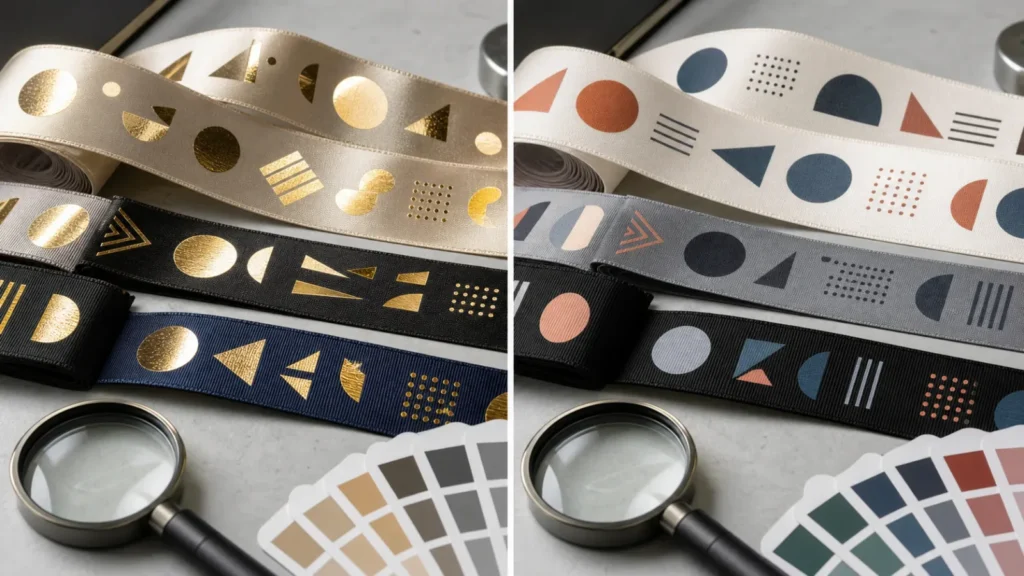
The sourcing record for metallic ribbon finish comparison for custom is incomplete until it identifies the right product type, structure, material, or specification.
Metallic finishes differ in how they reflect and in how they shed. The first sells the ribbon and the second brings it back.
Direct answer: For metallic ribbon finish comparison for custom, buyers should choose the right product type, structure, material, or specification.
Define the Buyer Decision for Metallic Ribbon Finish Comparison
| Option | Best fit | Trade-off | Risk to avoid | Verification | Follow-up |
|---|---|---|---|---|---|
| Current specification (standard metallic satin ribbon) | Orders where existing artwork and color match are approved and repeatable. | Limited finish variation; may not achieve the high-shine or matte effect requested for custom branding. | Color shift or adhesion failure when metallic ink is applied to a different ribbon substrate than originally tested. | Request a current production sample and compare against the approved standard under buyer-approved viewing conditions. | Document the approved standard with a signed sample card and store it with the spec sheet. |
| Custom option (bespoke metallic finish on buyer-supplied substrate or custom color match) | Brand-specific color codes (Pantone, CMYK) or a unique metallic effect (e.g., brushed, holographic). | Requires artwork approval, sample iteration, and a minimum order quantity (MOQ) confirmed by material and method. | Higher unit cost and longer lead time; no guarantee of repeatability without documented spec and retained samples. | Request a strike-off sample on the exact substrate and approve the color under production lighting. | Negotiate MOQ and lead time by RFQ; lock the spec with a signed approval form before production. |
| Safer fallback (standard non-metallic satin ribbon with a printed metallic effect) | Budget-sensitive orders or tight timelines where metallic ink risk is unacceptable. | Printed metallic effect lacks the reflective depth of true metallic ribbon; may look flat in direct light. | Color shift between print runs if the ink formulation is not locked with a retained sample. | Compare the printed fallback against the original metallic sample under store-display lighting. | Document the fallback spec as an approved alternative in the RFQ to avoid last-minute substitutions. |
For current specification (standard metallic satin ribbon), a poor decision can mean color shift or adhesion failure when metallic ink is applied to a different ribbon substrate than originally tested. Request a current production sample and compare against the approved standard under buyer-approved viewing conditions, then document the approved standard with a signed sample card and store it with the spec sheet.
For the current specification (standard metallic satin ribbon) checkpoint, keep the supplier response, marked sample, approved specification, quotation, and approval owner under the same revision number. If the evidence conflicts with the approved record, hold the quote, sample, or production release until the deviation is explained in writing. Carry the signed decision record into the purchase order, production handoff, shipment release, and later reorder review so every team works from the same baseline.
Material and specification fit
Metallic ribbon finish is not one-size-fits-all. Satin gives the brightest shine, but grosgrain holds shape better for bows. The substrate weave directly affects ink adhesion and color depth. Buyers should match the finish to the end-use: high-shine for gift wrap, structured edge for tags or rosettes. Always request a strike-off on the exact material before approving the spec.
MOQ, cost structure, and lead time
MOQ for custom metallic ribbon depends on material, print method, width, packing, and order schedule. Standard production runs 15-20 business days after spec and sample approval, but complex finishes add time. Cost per yard rises with custom color matching and sample iteration. Buyers should confirm MOQ by RFQ and factor in artwork review and shipping time when planning the order.
Supplier reliability and quality checks
Request the metallic-ribbon production sample, retained reference and agreed rub or colour checks. An amfori BSCI record concerns the factory social audit. FSC documentation here covers paper products, not metallic textile ribbon; review evidence relevant to the actual ordered construction.
Confirm Product and Order Scope
- Does the supplier have documented experience with metallic ribbon finishes? Metallic finishes require specific print and handling methods; general ribbon capability does not guarantee acceptable results. Supplier provides a portfolio of metallic ribbon orders and a process description for finish application. Unqualified supplier may deliver inconsistent sheen, flaking, or poor adhesion on metallic coating. Request a capability statement and three reference orders for metallic ribbon before RFQ.
- What verification method will you use to confirm metallic finish consistency? Visual approval alone is insufficient; measurable criteria prevent shipment rejection. Supplier uses a spectrophotometer or gloss meter and retains a sealed reference sample per production lot. Without a documented method, finish variation across rolls may go undetected until final inspection. Define acceptance tolerance for gloss and color in the specification sheet and sample approval form.
- What is the approval gate for metallic finish before bulk production? A signed-off production sample locks the finish standard and avoids rework costs. Supplier requires a signed approval on a physical sample before cutting any bulk material. Skipping formal approval can lead to bulk runs that do not match the expected metallic effect. Establish a written approval gate with a 48-hour review window in the production timeline.
- How do you handle metallic finish quality control during production? In-process checks catch defects early, reducing waste and ensuring consistent output. Supplier performs in-line visual inspection and random roll sampling for finish uniformity. Lack of QC may allow defective rolls to be shipped, causing delays and returns. Request a QC checklist and sampling frequency for metallic ribbon runs before order placement.
- What is your buyer follow-up process after sample approval? Clear communication ensures the approved finish is replicated exactly in bulk production. Supplier sends a production confirmation with the approved sample reference and lot number. Without follow-up, production may proceed with unapproved adjustments to the metallic finish. Confirm the supplier will issue a production confirmation document referencing the approved sample.
Decision criteria to confirm
Compare the supplier's metallic ribbon finish capability against your order scope. Ask for a finish sample on your specified material and width. Verify the sample against your color standard and gloss requirement. This step prevents mismatched expectations before any custom printed ribbon production begins.
RFQ details to send
Include finish type, gloss level, and acceptable tolerance in your RFQ. Specify whether you require a spectrophotometer reading or visual match. Confirm the supplier's MOQ for metallic finishes, as coating methods may increase minimums. Document these inputs to ensure accurate quoting and avoid cost surprises.
Production handoff details
After sample approval, confirm the supplier locks the finish specification and retains a sealed reference. Request a production confirmation that references the approved sample. This handoff ensures the bulk run matches the approved custom printed ribbon finish and reduces the risk of rework or rejection.
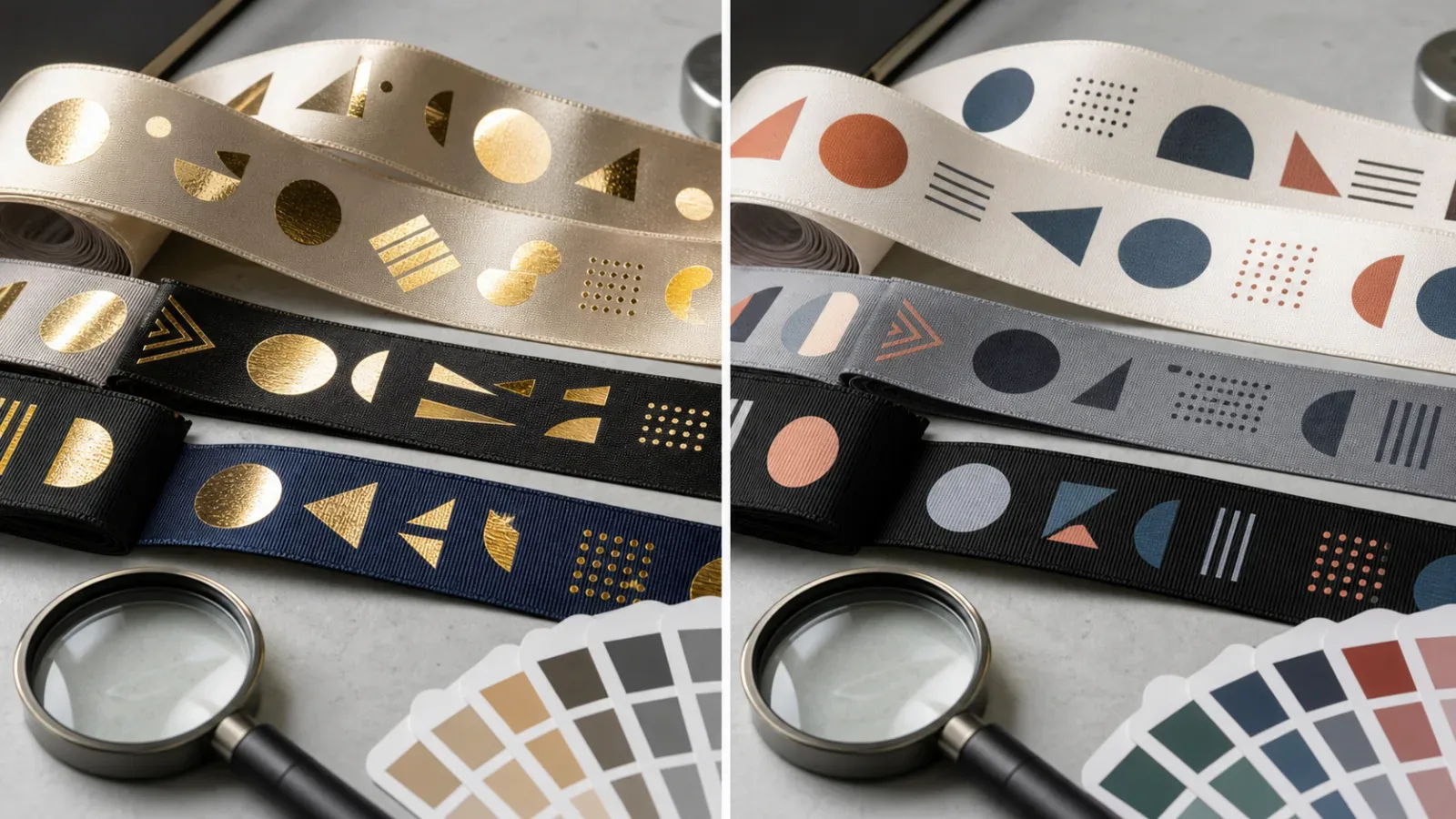
Build the Verification Checklist
Before moving to sample handoff, confirm that every spec, cost, production risk, and factory execution point is verified against an quote request-confirmed requirement. Use this ordered list as your buyer verification checklist:
- Specs: Verify that the metallic ribbon finish (e.g., gloss level, color match, coating type) matches the quote request-confirmed requirement. Ask: Is the finish consistent across the entire ribbon width and length?
- Cost or MOQ: Confirm that the unit price and minimum order quantity are explicitly stated in the quote request response. Ask: Are there any hidden costs for setup, tooling, or color matching?
- Production Risk: Identify potential issues such as coating adhesion failure, color variation between batches, or surface defects. Ask: What is the supplier’s process for handling defects or rework?
- Factory Execution: Validate that the supplier has the equipment and quality control to produce the finish at scale. Ask: Can the supplier provide a process flow chart or in-line inspection records?
- quote request/Sample Handoff: Ensure that the sample approval process includes a sign-off on finish appearance, dimensions, and performance. Ask: What documentation accompanies the sample (e.g., inspection report, certificate of compliance)?
Use this decision matrix as an approval sequence, not as a supplier comparison table. Each row represents a gate that must be passed before proceeding.
| Gate | Verification Question | Pass Criteria |
|---|---|---|
| Spec Confirmation | Does the finish meet the RFQ-confirmed requirement? | Yes, with documented evidence |
| Cost & MOQ Clarity | Are all costs and MOQ explicitly stated? | No hidden fees; MOQ acceptable |
| Risk Assessment | Are production risks identified and mitigated? | Risk register or mitigation plan exists |
| Factory Capability | Does the factory have proven execution capability? | Process documentation or audit result |
| Sample Handoff | Is the sample accompanied by full documentation? | Inspection report and sign-off form |
After passing all gates, the buyer can proceed to the next stage: placing a pilot order or scaling production. For more on custom ribbon development, see OEM and ODM ribbon development.
Compare Quote and Production Assumptions
| Criteria | Baseline option | Confirmed option | Buyer meaning | Risk to avoid | Follow-up |
|---|---|---|---|---|---|
| Specification completeness | Foil stamping requires die design, foil type, temperature range | Metallic ink requires color standard, substrate, ink viscosity | Determines how detailed the spec sheet must be for accurate quoting | Incomplete specs cause production errors and rework delays | Request supplier’s spec template and fill all fields before RFQ |
| Cost driver structure | High die engraving cost, low per-unit cost for long runs | Low setup cost, higher per-unit cost for short runs | For gift and retail packaging ribbon solutions solutions, the cost driver structure directly affects budget allocation | Choosing the wrong finish for your order volume inflates total cost | Request a cost breakdown for your volume and compare total cost per piece |
| Quality control checkpoints | Foil stamping tests adhesion, foil coverage, edge sharpness | Metallic ink tests color match, metallic effect consistency, rub resistance | QC method differs by finish; each requires specific inspection criteria | Overlooking the correct QC step leads to defective ribbon in shipment | Request the supplier’s QC checklist and confirm it covers your finish |
| Approval cycle and risk | Die approval and strike-off sample required before production | Color proof and press sample required before production | Approval steps affect timeline and require upfront coordination | Skipping formal approval leads to off-spec product and rejected deliveries | Include both approval gates in the project plan and allocate extra days for rework if needed |
For specification completeness, a poor decision can mean incomplete specs cause production errors and rework delays. Request written proof and compare it with the approved sample or specification, then request supplier’s spec template and fill all fields before quote request.
For metallic ribbon finish, preserve the specification completeness decision under one revision number: keep the supplier response, marked sample, approved specification, quotation, and approval owner together. If the evidence conflicts with the approved record, hold the quote, sample, or production release until the deviation is explained in writing. Carry that signed record into the purchase order, production handoff, shipment release, and later reorder review so every team works from the same baseline.
Run the Review Before Approval
Before approving a custom order, ensure the quote request-confirmed finish requirement is met. Use the checklist below to verify supplier responses against your order scope.
Questions to send back to the supplier
- What specific metallic finish (e.g., foil-stamped, laminated, or coated) is confirmed in the quote request, and what is the exact width tolerance?
- Can the supplier provide a sample of the metallic finish on the specified substrate for color and adhesion verification?
- What is the minimum order quantity (minimum order) for this finish, and are there cost implications for quantities below that threshold?
- How does the supplier handle production risk for metallic finishes, including potential delamination or color variation across batches?
- What is the factory’s standard quality check for metallic ribbon finishes before shipment?
When to revise, escalate, or reject
If the supplier cannot confirm the finish type or provide a sample, revise the order scope. Escalate if the minimum order or cost exceeds your budget without clear justification. Reject if the supplier lacks documented experience or fails to address production risks. Use the matrix below to guide your decision.
| Criteria | Pass | Revise | Reject |
|---|---|---|---|
| Finish confirmed in RFQ | Yes | Partial | No |
| Sample provided | Within supplier-confirmed timing | Delayed | Not available |
| MOQ fits budget | Yes | Negotiable | Exceeds limit |
| Production risk addressed | Documented plan | Vague | Not addressed |
After passing all criteria, proceed to sample handoff. For more on our process, visit Lude Ribbon factory.
Move from Review to RFQ or Sample
Select the metallic ribbon finish only after verifying that the supplier’s documented experience matches your order’s spec range. If the supplier has produced the same finish type (e.g., matte metallic, high-gloss metallic) on the same ribbon width and material substrate within the past 12 months, proceed to quote request or sample request.
Inputs to include in the next message
- Finish type and target gloss level (e.g., 60° gloss meter reading, if applicable).
- Ribbon width, material composition (e.g., polyester, nylon), and any coating specifications.
- Estimated annual volume and preferred order quantity range.
- Required lead time for first sample and production run.
- Any special handling or packaging requirements (e.g., anti-tarnish lining).
Ownership and sign-off for the next gate
Assign a single point of contact to own the quote request or sample request. That person must confirm the finish spec against the supplier’s capability statement before sending. No sign-off is needed from procurement until the supplier returns a quote or sample.
Use the table below to compare key decision factors before sending the request.
| Factor | Check |
|---|---|
| Specs | Does the supplier’s finish match your gloss and color tolerance? |
| Cost or MOQ | Is the per-unit cost within budget at the proposed MOQ? |
| Production risk | Has the supplier produced this finish without defects in the last 12 months? |
| Factory execution | Does the supplier have documented quality checks for metallic ribbon? |
| RFQ/sample handoff | Is the spec sheet complete and approved by your team? |
After the table is reviewed, send the quote request or sample request with the inputs listed above. The Lude Ribbon editorial team creates practical B2B ribbon and bow buying guides from applied experience with satin ribbon and other materials.
Source check: ISO 2859-1 sampling inspection standard; How to Build & Use a Vendor Comparison Matrix.
In conclusion
The sourcing choice for a metallic ribbon finish ultimately comes down to matching the supplier’s documented spec sheet with your order’s volume, timeline, and quality tolerance. Before you shortlist a supplier, compare the finish type—foil stamping, hot stamping, or metallic coating—against your substrate and end-use requirements, then validate the spec by requesting a physical sample. Approve that sample only after verifying the supplier’s written finish specification, as this step locks in the cost and minimum order assumptions for your custom program. A disciplined sample approval gate protects your procurement from rework and ensures the production run matches the approved standard.
To request a quote for metallic ribbon finish, use metallic ribbon to confirm the final specification, quote assumptions, sample approval, QC evidence, approval risk, and supplier follow-up before bulk order.
Metallic Ribbon Finish Comparison FAQ
What should buyers confirm first?
Buyers should first confirm the metallic ribbon finish type—foil stamping, hot stamping, or digital metallic ink—and verify that the supplier’s documented process matches the intended use. Check the specification sheet for width tolerance, color fastness, and any coating limitations, then request a cost breakdown and minimum order per finish option. Lead time will vary by method, so ask for a confirmed schedule in the quote request, and always order a pre-production sample to approve the metallic effect before bulk production begins.
Which proof should be retained for approval and reorders?
Retain the signed-off sample and the supplier’s written specification approval as proof for both initial approval and future reorders. Document the exact finish method, color code, width, and any special coating or backing requirements, and store a physical reference sample alongside the digital approval. When reordering, send the same spec sheet and sample photo to the supplier, and request a new pre-production sample if the order exceeds the original quantity or if more than six months have passed since the last run.
Which warning signs should stop the order?
Stop the order if the supplier cannot provide a documented finish specification, a physical sample, or a clear cost and minimum order breakdown for the chosen metallic method. Warning signs include vague lead time promises, refusal to share a sample before bulk production, or a finish that flakes, smudges, or fades on the test piece. If the supplier’s sample does not match the approved color or metallic effect, do not proceed until the issue is resolved and a corrected sample is approved in writing.
Next step: Send Specs for Review.
Keep exploring
Recommended buyer guides
 Wholesale Foil Printing vs Screen Printing Ribbon: Buyer Comparison
Foil printing vs screen printing ribbon: side-by-side on artwork files, print method, color target, and sample approval. Pick…
Explore guide
Wholesale Foil Printing vs Screen Printing Ribbon: Buyer Comparison
Foil printing vs screen printing ribbon: side-by-side on artwork files, print method, color target, and sample approval. Pick…
Explore guide
 Organza Ribbon Sheer Finish and Print Comparison for Custom Orders
 — the checks that decide whether a quote,…
Explore guide
Organza Ribbon Sheer Finish and Print Comparison for Custom Orders
Organza Ribbon Sheer Finish and Print Comparison for Custom Orders — the checks that decide whether a quote,…
Explore guide
 Velvet Ribbon Pile and Finish Comparison for Custom Orders Buyer
: what to confirm on material, MOQ, sample checks,…
Explore guide
Velvet Ribbon Pile and Finish Comparison for Custom Orders Buyer
Velvet Ribbon Pile and Finish Comparison for Custom Orders Buyer: what to confirm on material, MOQ, sample checks,…
Explore guide
 Award Ribbon Production Options: When to Custom Order Instead of DIY
Compare Award Ribbon Production Options by format, event timing, artwork placement, and packing before RFQ for retail packaging,…
Explore guide
Award Ribbon Production Options: When to Custom Order Instead of DIY
Compare Award Ribbon Production Options by format, event timing, artwork placement, and packing before RFQ for retail packaging,…
Explore guide
Leave a comment
Share a sourcing question or feedback on this guide. The Lude team reviews submissions before following up.