


Extra Wide Wired Ribbon: Large bows and displays
Extra Wide Wired Ribbon: what to check on artwork files, print method, color target, and material before placing a ribbon order

Extra wide wired ribbon needs a written specification before the buyer can decide whether Extra Wide Wired Ribbon fits the use case, specs, MOQ, sample approval path, and supplier quote process; otherwise suppliers may quote different product and approval assumptions.
This guide connects extra wide wired ribbon to parameters, cost impact, supplier risk, factory process, and procurement advice.
Direct answer: Use extra wide wired ribbon only after its specification, application fit, sample route, quantity rule, and supplier exceptions have been confirmed in writing.
When extra wide wired ribbon is the right size or format
| Option | Best fit | Trade-off | Risk to avoid | Verification | Follow-up |
|---|---|---|---|---|---|
| Stock-width wired material | Large bows, event backdrops, and retail displays requiring a readily available option | Choice is limited to existing width and color inventory | The selected width may be too narrow for the intended visual span or support structure | Compare a sample against the actual bow, package, or display dimensions | Request the available-width list and a color swatch set |
| Custom-width wired material | Branded displays or packaging programs requiring a non-standard proportion | Width feasibility, minimum order, setup, and lead time require written confirmation | An undocumented production setup may make reorders inconsistent | Ask for width tolerance, sample approval, and repeat-run controls | Submit target width, material, application, and forecast volume for review |
| Narrower format with reinforcement | Projects where budget or order quantity does not support a custom wide run | Extra loops or a frame can increase assembly time | A prototype may not hold its intended shape in transit or on display | Test the complete bow on the real package or display frame | Request sample material and document the reinforcement method |
Treat the table as an approval sequence. First choose the intended visual span and support method, then compare stock, custom-width, and reinforced alternatives using the same application. Keep the supplier response, marked sample, approved specification, quotation, and approval owner under one revision number. If the evidence conflicts with the approved record, hold the quote or production release until the deviation is explained in writing.
Best-fit packaging and display uses
Extra wide wired ribbon is most useful when one shaped element must occupy substantial visual space, such as a retail window bow, event backdrop, or oversized gift presentation. The wire edge lets the team reshape a sample during prototyping, but the buyer should still test the finished bow on the real package or display structure before approving bulk production.
When to choose a wider, narrower, or different format
Choose the wide format when a single bow must carry the main visual effect. Use a narrower option for trim, smaller packages, or tight curves, and add reinforcement only after assembly time and transit performance have been tested. For a custom width, ask the supplier to document tolerance, sample approval, minimum order, setup assumptions, and the controls used for repeat runs.
Use the evidence for when extra wide wired ribbon is the right size or format to compare the supplier record with ISO 2859-1 sampling inspection standard before accepting the requirement.
Width, roll length, material, and finish choices
| Requirement | Factory control | Evidence to verify | Order risk | RFQ follow-up |
|---|---|---|---|---|
| Material / substrate | Compare substrate against approved swatch for weave, weight, and hand feel. | Inspect production roll against sealed reference sample under buyer-approved viewing conditions. | Substrate substitution alters bow structure and durability in transit. | Request RFQ with material spec and confirm substrate on pre-production sample. |
| Finish or surface effect | Verify finish consistency (matte, sheen, texture) across roll face and edges. | Run hand-feel and visual check under 60° gloss meter on production sample. | Uneven finish leads to rejected bows and inconsistent brand presentation. | Shortlist finish options and request RFQ for preferred surface effect. |
| Roll length or spool format | Document actual yardage per roll against declared length using calibrated counter. | Weigh full roll and compare to standard weight-per-yard for that material. | Short rolls disrupt production runs and inflate per-unit cost unexpectedly. | Verify roll length on sample and document in RFQ follow-up. |
How size affects appearance and handling
Wider ribbon widths create larger, more dramatic loops that hold shape better in high-visibility displays, but they require more material per bow and may need reinforced wire to prevent sagging. Narrower widths offer tighter, more controlled loops suitable for smaller packaging or accent bows. The buyer should compare the intended display scale and handling frequency against the width options during sample approval, as the same material in different widths behaves differently under tension and folding.
Material and finish constraints by use case
Polyester satin delivers a consistent sheen and color fastness for indoor retail or event use, while grosgrain offers a textured, matte finish that resists fraying in high-handling applications like gift wrap or uniform trim. Velvet and organza provide distinct tactile and visual effects but require careful handling during bow assembly. The buyer must confirm the material and finish against the end-use environment, including light exposure, humidity, and repeated bending, before committing to a production run. Confirm all commercial numbers in the written RFQ, including the exact MOQ and lead time for your chosen material and finish combination.
Printing, bow-making, and packing limits
Build the quote request around the finished application. Give the supplier the target dimensions, wire and edge construction, material, color reference, artwork file and repeat, roll format, bow-making method, packing unit, and planned quantity by design.
| RFQ input | Supplier question | Proof to request | approval risk | Buyer action |
|---|---|---|---|---|
| Width, wire, edge, and material | Which construction and tolerance can the line repeat? | Measured pre-production sample | The sample cannot hold the required shape or dimensions | Revise the construction or keep the quote on hold |
| Artwork, printable area, and repeat | Where are the wire channel, safe area, and repeat limits? | Marked artwork proof and printed sample | The logo clips or the repeat changes on the finished ribbon | Correct the artwork before sample approval |
| Bow-making or display assembly | What cut length, shaping route, and support does the application need? | Prototype on the actual package or display frame | Assembly time rises or the prototype collapses in handling | Test an alternative width or reinforcement method |
| Roll, inner pack, and export carton | How will the roll and carton protect the edge in transit? | Packing photo or representative carton | Compression, kinking, or movement damages usable material | Revise the pack and repeat the transit check |
Logo or artwork fit considerations
On extra wide wired ribbon, the usable print area can be narrower than the visible face because the wire channel and edge finish occupy part of the width. Ask the supplier to mark the printable area and repeat on the artwork proof, then check a printed sample on the intended bow or display.
Ask the supplier to quote each artwork, color, and construction separately, identify which setup can be shared, and state the lead-time trigger in writing. This shows whether the buyer should reduce design count, change the process, or revise the launch schedule.
Packing and storage details to confirm
Use OEM and ODM ribbon development as service context when the project needs a non-standard construction or packing route. The final packing record should identify winding direction, roll protection, core, carton quantity, dimensions, weight, labeling, and storage precautions.
Before bulk approval, inspect a packed sample or representative carton for edge compression, wire kinking, print scuffing, and movement in transit. Keep that evidence with the specification and quotation for production and reorder checks.
MOQ, sample, and reorder planning
- Verify MOQ against planned order volume: Ordering below the factory's minimum triggers per-yard surcharges or order rejection, disrupting launch timing. Compare your forecasted yardage to the supplier's stated minimum order for plain stock, custom print, or custom color ribbon. Short-paid invoice, delayed production, or forced renegotiation of unit price. Document the minimum order figure in the quote request response and confirm it applies to your chosen width and finish.
- Approve sample against production spec sheet: A sample that matches width, wire placement, color, and roll length prevents a bulk run that deviates from the approved proof. Hold the sample beside the signed spec sheet and measure width, wire gauge, and repeat interval under a ruler. Bulk ribbon that does not fit bow machines or display fixtures, requiring rework at buyer cost. Shortlist the sample only after the spec sheet is marked approved and dated by both parties.
- Check reorder lead time and capacity: gift and retail packaging ribbon solutions solutions often require rapid replenishment; a supplier without open capacity cannot meet seasonal spikes. Ask for the current production queue and standard lead time (e.g., 15–20 business days after spec confirmation) and whether rush service is available. Stockouts during peak promotion windows, forcing last-minute substitution of non-approved ribbon. Document the confirmed lead time in the purchase order and set a reorder trigger date.
- Confirm artwork proof for printed ribbon: Misaligned print or color shift on a wide ribbon destroys brand appearance and may render the entire run unusable. Review the digital proof for repeat alignment, color match to Pantone reference, and bleed margins at the specified width. A full production run with off-register logos or wrong color, requiring reprint at buyer expense. Approve the proof in writing only after all alignment and color checks pass.
What changes with custom color or custom print
Custom color dyeing and custom print each carry separate minimum order thresholds and approval gates. A custom Pantone-dyed satin run starts at 5,000 yards per color, while a printed design requires 3,000 yards per program. Both demand a signed artwork proof and a lab dip or strike-off before bulk production begins.
How to keep repeat orders consistent
Lock the approved spec sheet, sample, and artwork proof into a master file that the factory references for every reorder. Include the width, wire type, color code, roll length, and packing method. Without this file, a repeat order may drift in shade, wire stiffness, or print registration, forcing a new approval cycle.
Quote checklist for this specification
- What is the finished width tolerance the supplier guarantees for extra wide wired ribbon? Width deviation affects bow symmetry and display fit; a supplier that cannot hold the buyer-approved tolerance on wide widths may produce unusable stock. Supplier provides a written width tolerance per production lot and agrees to measure at three points per roll. Accepting unverified width claims leads to rework or scrapped inventory when ribbons do not align with fixture slots. Request a width measurement report from the last three production lots before placing the order.
- Does the supplier produce the wire edge in-house or outsource it? In-house wire insertion gives the supplier direct control over edge tension and wire gauge consistency, reducing breakage during bow tying. Supplier confirms in-house wire edge production with documented QC checks on wire placement and edge fold. Outsourced wire edge can introduce variability in tension and alignment, leading to customer complaints about loose wire or uneven loops. Ask for a video or photo of the wire-edge station and the last QC pass record.
- What is the minimum order quantity for a custom width in this extra wide wired ribbon? Custom widths require loom setup and wire-edge tooling changes; minimum order thresholds protect both parties from uneconomical short runs. Supplier states a clear minimum order per width variant and explains how they handle width changes within the same material. Ordering below minimum order may trigger hidden surcharges or force the supplier to split a larger run, delaying delivery. Confirm the minimum order in writing and ask whether a sample width can be produced at the same minimum order before committing to bulk.
Inputs to send before RFQ
Send the exact finished width you need, measured from edge to edge including the wire fold. Also specify the wire gauge preference—single or double wire—and whether the wire must be enclosed in a woven edge or added as a separate hem. These inputs let the factory calculate loom setup, tooling, and material yield before quoting.
Sample approval points
Check the sample against your width spec using a calibrated ruler at three points along the roll. Verify the wire stays inside the edge fold without puckering and that the ribbon lays flat when unspooled. Sign off only after measuring bow loops tied from the sample to confirm the width holds shape under tension.
In conclusion
For extra wide wired ribbon, the final approval comes down to verifying the four core specifications—width, wire type, edge finish, and material—against the approved sample before bulk production begins. Compare minimum order and lead time across shortlisted suppliers, and document every spec, artwork proof, and sample approval in a master file to eliminate reorder risk. Once the pre-production sample matches the approved spec sheet, you can confidently approve the order and move to production scheduling.
To request a quote for extra wide wired, use wired edge ribbon to confirm the final specification, quote assumptions, sample approval, QC evidence, approval risk, and supplier follow-up before bulk order.
Extra wide wired ribbon FAQ
What should buyers confirm before ordering Extra Wide Wired Ribbon?
Buyers should confirm the exact width, wire type (e.g., single or double wire, centered or offset), and edge finish (no fraying) before ordering. Verify that the intended use—such as large bows or displays—matches the ribbon’s stiffness and roll length, and document these specifications in the quote request to avoid mismatched production.
How should buyers compare MOQ, lead time, and quote terms?
Compare minimum order and lead time by submitting the exact width, material, and quantity to each supplier. For extra wide wired ribbon, plain stock may have a lower minimum order than custom printed or custom color options, and lead time typically starts after spec confirmation—confirm the exact number in the quote request. Check if the quote includes sample costs and whether rush production is available for a surcharge.
What sample, quality, or supplier checks reduce risk?
Reduce risk by requesting a pre-production sample that matches the approved spec sheet, including wire placement and edge finish. Verify the supplier’s quality control process for color consistency and fraying, and document the sample approval before bulk production. For supplier risk, check their social audit scope—such as amfori BSCI—and confirm it applies to ribbon production, not just paper products.
quote request handoff: Send Specs for Review.
Keep exploring
Recommended buyer guides
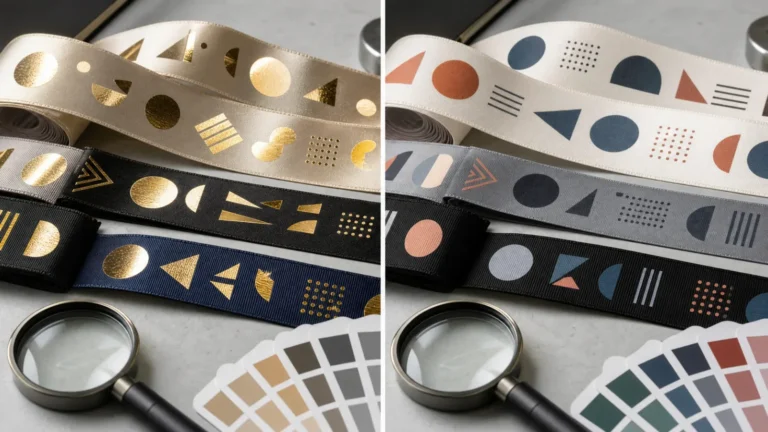
 Wholesale Foil Printing vs Screen Printing Ribbon: Buyer Comparison
Foil printing vs screen printing ribbon: side-by-side on artwork files, print method, color target, and sample approval. Pick…
Explore guide
Wholesale Foil Printing vs Screen Printing Ribbon: Buyer Comparison
Foil printing vs screen printing ribbon: side-by-side on artwork files, print method, color target, and sample approval. Pick…
Explore guide
 Organza Ribbon Sheer Finish and Print Comparison for Custom Orders
 — the checks that decide whether a quote,…
Explore guide
Organza Ribbon Sheer Finish and Print Comparison for Custom Orders
Organza Ribbon Sheer Finish and Print Comparison for Custom Orders — the checks that decide whether a quote,…
Explore guide
 Velvet Ribbon Pile and Finish Comparison for Custom Orders Buyer
: what to confirm on material, MOQ, sample checks,…
Explore guide
Metallic Ribbon Finish Comparison for Custom Orders: Buyer Checklist
Metallic Ribbon Finish Comparison for Custom Orders: what to confirm on material, dimensions, finish, and handling before you…
Explore guide
Velvet Ribbon Pile and Finish Comparison for Custom Orders Buyer
Velvet Ribbon Pile and Finish Comparison for Custom Orders Buyer: what to confirm on material, MOQ, sample checks,…
Explore guide
Metallic Ribbon Finish Comparison for Custom Orders: Buyer Checklist
Metallic Ribbon Finish Comparison for Custom Orders: what to confirm on material, dimensions, finish, and handling before you…
Explore guide
Leave a comment
Share a sourcing question or feedback on this guide. The Lude team reviews submissions before following up.