


Velvet Ribbon Supplier Audit Checklist: Bulk Specs and Supplier Checks
Velvet Ribbon Supplier Audit Checklist: what to confirm on factory capability, QC proof, lead time, and reorder reliability before you sample, quote
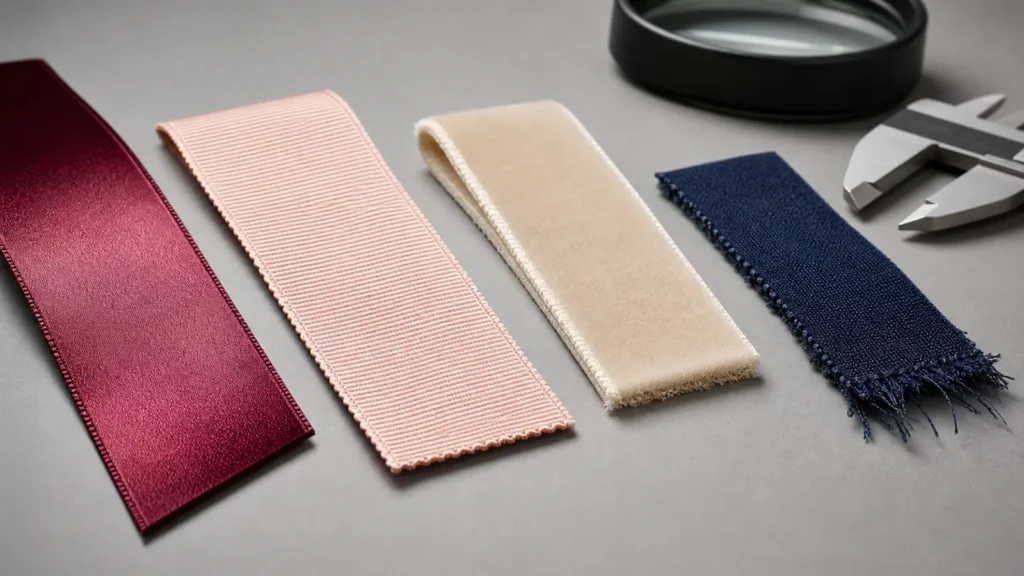
The sourcing record for velvet ribbon supplier audit is incomplete until it compares suppliers, factory proof, samples, MOQ, lead time, and risk signals.
Velvet audits check pile density and backing, because those two determine whether the ribbon recovers after being crushed.
Direct answer: For velvet ribbon supplier audit, buyers should compare suppliers, factory proof, samples, MOQ, lead time, and risk signals.
Define the Buyer Decision for Velvet Ribbon Supplier Audit
Compare the decision criteria for velvet ribbon supplier against one RFQ revision. Each row should identify the requirement, approval evidence, and buyer action before production.
| Requirement | Factory control | Evidence to verify | Order risk | RFQ follow-up |
|---|---|---|---|---|
| Sample approval | Supplier maintains a sealed reference sample and signed spec sheet for each production lot. | Request a pre-production sample; compare against approved standard under buyer-approved viewing conditions and measure pile height with a calibrated gauge. | Without a locked sample, color or texture drift can cause rework or order rejection at final inspection. | Ask RFQ to include sample turnaround time and number of revision rounds included. |
| MOQ and order quantity | Factory defines MOQ per width, color, and finish; confirms capacity for your forecast quantity. | Request a written MOQ schedule by SKU; verify that the supplier can scale without splitting lots across multiple dye batches. | Underestimating MOQ may force over-ordering or incur short-run surcharges that erode margin. | Request RFQ with tiered pricing for 1x, 3x, and 5x your target volume. |
| Material / substrate | Supplier certifies fiber type (e.g., 100% polyester or rayon blend) and yarn denier used in the velvet pile. | Request a material declaration and burn test report; cross-check against your spec sheet for fiber content and flame retardancy requirements. | Substituting a cheaper substrate can alter hand feel, drape, and wash durability, leading to customer complaints. | Ask RFQ to include a material data sheet and a swatch for hand-feel approval. |
| Width or size tolerance | Factory uses a laser or mechanical guide to maintain width within the buyer-approved tolerance across the entire roll length. | Measure three points per roll (start, middle, end) with a calibrated steel ruler; record any deviation in the inspection log. | Width variation beyond tolerance causes uneven cutting, wasted fabric, and assembly line stoppages. | Request RFQ to state the guaranteed width tolerance and the method used to measure it. |
| Finish or color control | Supplier performs visual inspection under controlled lighting and uses a spectrophotometer for buyer-approved color tolerance against the approved standard. | Review the color pass/fail report for each dye lot; request a lab dip for every new color before bulk production. | Batch-to-batch color variation can make matched sets unsellable and force costly re-dye or markdowns. | Ask RFQ to include the number of shade bands offered and the cost of a custom color match. |
For velvet ribbon supplier, use the decision criteria as the decision scope. Read the rows as one approval sequence. Start with sample approval; use the risk and buyer-action columns to decide whether its evidence is sufficient. Verify it with the inspection method and approval evidence recorded in the table.
For this velvet ribbon supplier sourcing record, keep the supplier response, marked sample, and approval owner under the same revision number. If any proof conflicts with the approved record, hold the quote, sample, or production release until the supplier explains the deviation in writing. Before closing the checkpoint, reconcile the latest drawing, sample, quotation, and approval comments, identify which record controls if they disagree, and document the resolution. Carry the signed decision criteria table into the purchase order and production handoff so the same checks support quote comparison, sample approval, shipment release, and later reorders.
Material and specification fit
The buyer decision begins by confirming that the supplier’s material substrate, width tolerance, and finish controls align with the intended end-use. A velvet ribbon destined for apparel trim requires different pile density and wash-fastness than one used in gift packaging. Auditing these parameters early prevents mismatched hand feel or dimensional instability that would surface only after bulk production.
MOQ, cost structure, and lead time
Once specifications are locked, the commercial terms determine whether the supplier is a viable partner. A factory that cannot state its MOQ per color or width may later impose hidden minimums that inflate inventory cost. Lead time should be quoted in business days after sample approval, with clear separation between standard production and any rush surcharge. Comparing these figures across shortlisted mills reveals which supplier can support your order cadence without premium fees.
Supplier reliability and quality checks
Reliability is verified through documented quality checks rather than promises. A supplier that cannot present a sample approval protocol, a color control log, or a width measurement record introduces order risk. The audit should confirm that the factory uses calibrated instruments and retains signed spec sheets for each production lot. These records become the evidence base for approving the supplier and setting the RFQ follow-up actions.
Questions to confirm before ordering:
- What are the exact width, pile height, and fabric composition for the velvet ribbon? Specs define the look and feel; a mismatch causes rework or rejection. Supplier provides a written spec sheet with tolerances and a sealed sample. Approving vague specs leads to bulk runs that fail quality checks. Document the spec and request a sealed sample before RFQ.
- What is the supplier's MOQ, cost per unit, and standard lead time for this velvet ribbon? Cost and lead time determine if the supplier fits your order schedule and budget. Supplier quotes a negotiable minimum order by material and width, with a 15–20 business day lead time after spec confirmation. Hidden minimum order or long lead time delays production or exceeds budget. Confirm minimum order and lead time in writing; add artwork review and shipping time to the schedule.
- How does the supplier ensure consistent color, pile, and width across production runs? Consistency protects your brand; uneven ribbon damages finished goods. Supplier uses a documented QC process with in-line inspection and a retained sample from each dye lot. Inconsistent runs cause returns, rework, or customer complaints. Request a QC checklist and a sample from the first production run before bulk approval.
- What is the supplier's process for handling defective or off-spec velvet ribbon? A clear defect policy prevents disputes and ensures you get usable goods. Supplier provides a written defect rate threshold and a replacement or credit process. No defect policy leaves you paying for unusable ribbon. Include defect terms in the purchase order and agree on a sampling plan per ISO 2859-1.
The buyer decision starts with confirming that the velvet ribbon's width, pile height, and fabric composition match your end-use requirements. A supplier that cannot state these specs in writing with tolerances introduces risk of bulk-run failure. Always request a sealed sample and signed spec sheet before moving to quote request.
minimum order and lead time directly affect your order feasibility and cash flow. A reliable supplier quotes a negotiable minimum order by material and width, with a standard 15–20 business day lead time after spec confirmation. Verify these numbers in writing and add artwork review and shipping time to avoid schedule surprises.
Consistency across production runs protects your brand from returns and complaints. Ask the supplier how they maintain color, pile, and width uniformity, and request a documented QC process. A clear defect policy with a replacement or credit process prevents disputes and ensures you receive usable goods.
Confirm Product and Order Scope
| Option | Best fit | Trade-off | Risk to avoid | Verification | Follow-up |
|---|---|---|---|---|---|
| Current specification velvet ribbon | Matches approved substrate, width tolerance, and edge finish for repeat orders. | No flexibility for cost reduction or alternative construction if supply tightens. | Supplier may drift from approved spec without documented pile-inspection and tension-control steps. | Check supplier's in-process QC records for pile height and width consistency per lot. | Request the last three production batch reports before placing the next order. |
| Alternative specification velvet ribbon | Uses a different substrate or width to meet a lower price point or faster delivery. | May require new artwork approval and sample sign-off, extending the procurement timeline. | Edge finish or dye lot may not match current inventory, causing assembly-line rejects. | Compare physical sample against approved standard under buyer-approved viewing conditions and measure width at three points. | Submit alternative spec sample for written approval before any bulk commitment. |
| Custom option velvet ribbon | Tailored color, print, or construction for a specific program or brand launch. | Requires dedicated tooling or minimum run that locks inventory and limits reorder flexibility. | Custom dye or jacquard pattern may not be repeatable across production runs without documented setup records. | Confirm supplier maintains a retained sample and setup card for each custom specification. | Document the custom spec in a controlled spec sheet signed by both parties before production. |
| Safer fallback velvet ribbon | Standard width and finish that multiple suppliers can produce without new tooling. | May lack the exact aesthetic or hand feel required for premium packaging or garment trim. | Fallback spec may not pass end-customer quality review if substituted without prior notification. | Cross-reference fallback spec against the approved OEM and ODM ribbon development records on file. | Stock a small buffer of fallback ribbon to cover emergency orders while maintaining primary spec. |
For current specification velvet ribbon, a poor decision can mean supplier may drift from approved spec without documented pile-inspection and tension-control steps. Ask the supplier to check supplier's in-process qc records for pile height and width consistency per lot, then request the last three production batch reports before placing the next order.
For the current specification velvet ribbon checkpoint, keep the supplier response, marked sample, approved specification, quotation, and approval owner under the same revision number. If the evidence conflicts with the approved record, hold the quote, sample, or production release until the deviation is explained in writing. Carry the signed decision record into the purchase order, production handoff, shipment release, and later reorder review so every team works from the same baseline.
Decision criteria to confirm
Before you compare options, confirm that the velvet ribbon substrate, width tolerance, and edge finish on the supplier's quote match your approved spec sheet exactly. A mismatch at this stage can delay production by two weeks and add rework cost. Use the decision matrix below to weigh each route against your order scope and risk tolerance.
RFQ details to send
When you send an quote request for velvet ribbon, include the exact spec reference, acceptable tolerance range, and any packaging or labeling requirements. Suppliers need this detail to quote accurately and avoid pricing based on assumptions. Missing inputs often lead to price adjustments later or non-conforming goods.
Production handoff details
Once you select an option, issue a signed production-order confirmation that references the approved spec sheet and sample. Require the supplier to send a first-article inspection report before the bulk run begins. This handoff step prevents the factory from interpreting the spec differently and catching errors after the ribbon is already on the loom.
Build the Verification Checklist
At this process checkpoint, you have completed the quote request revision and now need a structured checklist to verify each supplier against bulk specs and factory execution. The output must be a completed checklist that confirms readiness before moving to sample handoff.
- Specs Verification: Confirm ribbon width, thickness, dye lot consistency, and edge finish against your spec sheet. Request a physical spec card or digital measurement report.
- Cost & minimum order Alignment: Validate that unit pricing matches the quote request and that minimum order quantities are feasible for your production run. Flag any hidden fees for tooling or setup.
- Production Risk Assessment: Review the supplier’s quality control plan, including in-line inspection points and defect rate targets. Ask for a process flow diagram to identify bottlenecks.
- Factory Execution Check: Verify production capacity for your order volume, lead time commitments, and shipping terms. Request a factory audit report or third-party certification (e.g., ISO 9001) if available.
- quote request & Sample Handoff: Ensure the supplier has acknowledged all quote request terms and can provide pre-production samples within agreed timelines. Document the sample approval process and sign-off criteria.
Use this checklist as a decision matrix to approve or reject suppliers before proceeding to bulk production. Each row in the table below maps a key area to a verification action and required output.
| Area | Verification Action | Required Output |
|---|---|---|
| Specs | Compare physical sample to spec sheet | Measurement report |
| Cost | Reconcile invoice with RFQ pricing | Cost breakdown |
| Risk | Review QC plan and defect history | Risk assessment log |
| Execution | Confirm capacity and lead time | Production schedule |
| Handoff | Approve sample and sign off | Sample approval form |
After completing the checklist, proceed to sample handoff with documented evidence that all criteria are met. For custom printed ribbon needs, see our custom printed ribbon options.
Compare Quote and Production Assumptions
For velvet ribbon supplier, treat the listed items as quote request inputs. Match each buyer input to written supplier confirmation, approval evidence, and the risk that would hold the quote.
- Specification details: velvet ribbon width, pile height, and composition: A mismatch in pile height or fiber blend changes the hand feel and appearance, which can break a retail packaging aesthetic. You may receive ribbon that does not match your gift and retail packaging ribbon solutions solutions, leading to rejected shipments and reorder costs. Attach the signed specification sheet to the quote request and require the supplier to confirm each dimension in writing before quoting.
- minimum order or order quantity per color and per design: minimum order directly affects unit cost and inventory risk; a supplier with a high minimum order may force over-ordering on slow-moving colors. You may lock into a quantity that exceeds your budget or creates dead stock, eroding margin on the full program. Request minimum order broken out by color, design, and material width, and confirm whether split orders across SKUs count toward the minimum.
- Lead time from specification approval to shipment: Lead time determines when you can launch a seasonal program; a delay of even one week can miss a retail shelf reset window. One buyer approved specs on day 1 but the supplier quoted 20 business days after artwork sign-off, which pushed delivery past the campaign start. You may commit to a delivery date that the supplier cannot meet, causing expedited freight costs or lost sales. Ask the supplier to state lead time in calendar days from approved sample and include artwork review and shipping separately.
- Cost driver: dye lot, cutting waste, and finishing method: Velvet ribbon cost is driven by dye-lot size and edge-finishing technique; a small run with hot-cut edges costs more per yard than a large run with laser-cut edges. You may compare unit prices without understanding the volume and finishing assumptions, leading to a false lowest-cost decision. Request a cost breakdown by volume tier and finishing method, and confirm which cost drivers are fixed versus variable per order.
Run the Review Before Approval
At this checkpoint, you have received supplier responses to your quote request. The output that must exist before proceeding is a verified confirmation that each supplier’s offer matches your velvet ribbon specifications and production requirements. Use this structured review to filter out weak candidates before sample handoff.
Questions to send back to the supplier
- Can you confirm the ribbon width, fiber content, and dye lot consistency?
- What is your standard lead time from order confirmation to shipment?
- What is the minimum order quantity per color and per SKU?
- Do you provide a pre-production sample or a shade card for approval?
- How do you handle defects or color variation in bulk production?
When to revise, escalate, or reject
Use the table below to evaluate each supplier response against your quote request requirements. If the supplier fails any critical criterion, decide on the buyer follow-up.
| Criterion | Pass | Revise | Escalate | Reject |
|---|---|---|---|---|
| Specification match | All specs confirmed in writing | Minor discrepancy, request clarification | Major discrepancy, engage senior buyer | Cannot meet key specs |
| Lead time | Within your required window | Close but needs adjustment | Extended beyond acceptable range | Unacceptable delay |
| Minimum order quantity | Below your target volume | Above target but negotiable | Significantly higher, request alternative | Refuses to adjust |
| Sample quality | Passes visual and tactile inspection | Minor issues, ask for resample | Consistent problems, involve quality team | Poor quality, reject |
| Production capability | Factory audit or documentation provided | Partial documentation, request more | No proof of capability, require audit | Unable to demonstrate |
After applying this checklist, you will have a clear decision path for each supplier. Only proceed to sample handoff with suppliers that have met all pass criteria or have a clear revision plan. For more on our sourcing approach, visit Lude Ribbon factory.
Move from Review to RFQ or Sample
Before sending the quote request or requesting samples, confirm that the supplier has provided a written measurement record for the velvet ribbon’s width and thickness. This record makes the decision verifiable and ensures alignment with your bulk specs.
Inputs to include in the next message
- Confirm the supplier’s written measurement of ribbon width and thickness against your quote request requirement.
- Request a cost breakdown per unit and confirm minimum order quantity in writing.
- Ask for a production risk assessment, including common defects like fraying or color variation.
- Verify factory execution capability by requesting a recent batch inspection report.
Ownership and sign-off for the next gate
Assign one person to own the quote request or sample request and to collect the supplier’s written confirmations. Sign-off requires that all four inputs above are documented and reviewed by the procurement lead before proceeding.
| Checkpoint | Buyer Verification Question | Supplier Confirmation Required |
|---|---|---|
| Specs | Does the supplier’s measurement match your RFQ requirement? | Written width and thickness record |
| Cost/MOQ | What is the unit cost and minimum order quantity? | Cost breakdown and MOQ in writing |
| Production Risk | What common defects are addressed in quality control? | Risk assessment document |
| Factory Execution | Can the supplier provide a recent batch inspection report? | Inspection report copy |
Once these confirmations are collected, you can move to the quote request or sample stage with confidence.
Source check: ISO 2859-1 sampling inspection standard; Supplier Risk Assessment Checklist: Key Areas to Review – Legal…; The First 72 Hours: How to Audit Your Current Cross-Border Toil….
In conclusion
The sourcing choice for velvet ribbon ultimately comes down to how thoroughly you compare each supplier against your confirmed specification, cost structure, and quality risk. By documenting every quote request response, verifying the supplier’s production proof and sample approval, and checking lead time and minimum order alignment, you create a clear audit trail that supports a confident shortlist. Once you have validated the spec and approved the sample, the final step is to request a quote from your top candidates to lock in the commercial terms.
To request a quote for velvet ribbon supplier, use velvet ribbon to confirm the final specification, quote assumptions, sample approval, QC evidence, approval risk, and supplier follow-up before bulk order.
Velvet Ribbon Supplier Audit FAQ
What should buyers confirm first?
Confirm the velvet ribbon specification: width, pile height, fabric composition, and colorfastness. Verify the supplier’s minimum order for the required width and packing, and request a lead time quote (standard production is 15–20 business days after spec confirmation, but confirm per quote request). Assess supplier risk by checking for a factory audit report or third-party quality certification. Order a sample to test hand feel, dye consistency, and seam slippage before bulk commitment.
Which proof should be retained for approval and reorders?
Retain the approved sample with its signed specification sheet, including the color standard (Pantone or lab dip), width tolerance, and pile height. Keep the supplier’s quality control report for the batch and a copy of the signed purchase order with agreed minimum order, unit price, and lead time. For reorders, the same specification sheet and sample reference ensure consistency. Also retain email correspondence confirming artwork approval, sample approval, and any deviation waivers.
Which warning signs should stop the order?
For velvet ribbon supplier audit checklist, turn the answer into a written quote request note: intended use, ribbon width, material, finish, packing method, and approval owner. Ask the supplier what sample proof or QC record will confirm the same result in production. A vague answer can turn into quote mismatch, sample delay, packing damage, or repeat-order drift.
Next step: Send Specs for Review.
Keep exploring
Recommended buyer guides
 Velvet Ribbon Wholesale Checklist: MOQ, Finish, and Supplier Questions
Evaluate velvet ribbon wholesale options: MOQ, setup fees, unit cost, and packing. Narrow the list before requesting samples…
Explore guide
Velvet Ribbon Wholesale Checklist: MOQ, Finish, and Supplier Questions
Evaluate velvet ribbon wholesale options: MOQ, setup fees, unit cost, and packing. Narrow the list before requesting samples…
Explore guide
 Wholesale Ribbon By The Roll: Roll length and inventory planning
Evaluate Wholesale Ribbon By The Roll options: factory capability, QC proof, lead time, and reorder reliability. Narrow the…
Explore guide
Wholesale Ribbon By The Roll: Roll length and inventory planning
Evaluate Wholesale Ribbon By The Roll options: factory capability, QC proof, lead time, and reorder reliability. Narrow the…
Explore guide
 Award Ribbons Wholesale: Bulk award ribbon supplier checks
Shortlist Award Ribbons Wholesale suppliers by factory capability, QC proof, lead time, and reorder reliability. See which options…
Explore guide
Award Ribbons Wholesale: Bulk award ribbon supplier checks
Shortlist Award Ribbons Wholesale suppliers by factory capability, QC proof, lead time, and reorder reliability. See which options…
Explore guide
 Wholesale Ribbon Manufacturers: Factory vs Trading Company Checklist
Evaluate Wholesale Ribbon Manufacturers options: factory capability, QC proof, lead time, and reorder reliability. Narrow the list before…
Explore guide
Wholesale Ribbon Manufacturers: Factory vs Trading Company Checklist
Evaluate Wholesale Ribbon Manufacturers options: factory capability, QC proof, lead time, and reorder reliability. Narrow the list before…
Explore guide
Leave a comment
Share a sourcing question or feedback on this guide. The Lude team reviews submissions before following up.